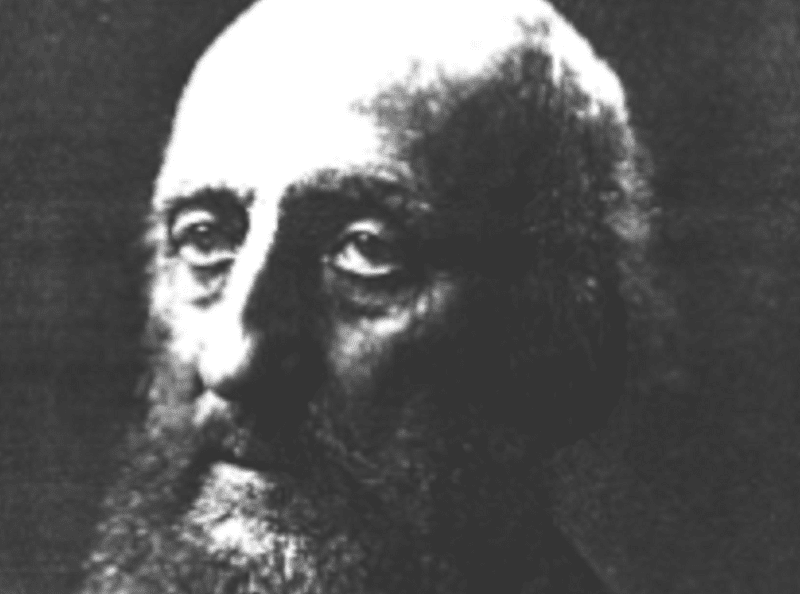

James Renwick Jr. is one of the greatest architects of his time. He designed churches, hotels, commercial facilities, as well as houses for wealthy residents of the United States. He was born on November 11, 1818, in Bloomingdale and died on June 23, 1895, New York. Let’s explore the biography of the architect in more detail on i-manhattan. Countless buildings were designed and built under his guidance. They are valuable from a historical point of view and still exist.
Biography and the career start of the outstanding creator
James Renwick Jr. was born into a rich and educated family. His dad was an architect, engineer, scientist and professor at Columbia College. James’s mother, Margaret Brevoort, came from a rich and well-known local family. His two brothers also became engineers.
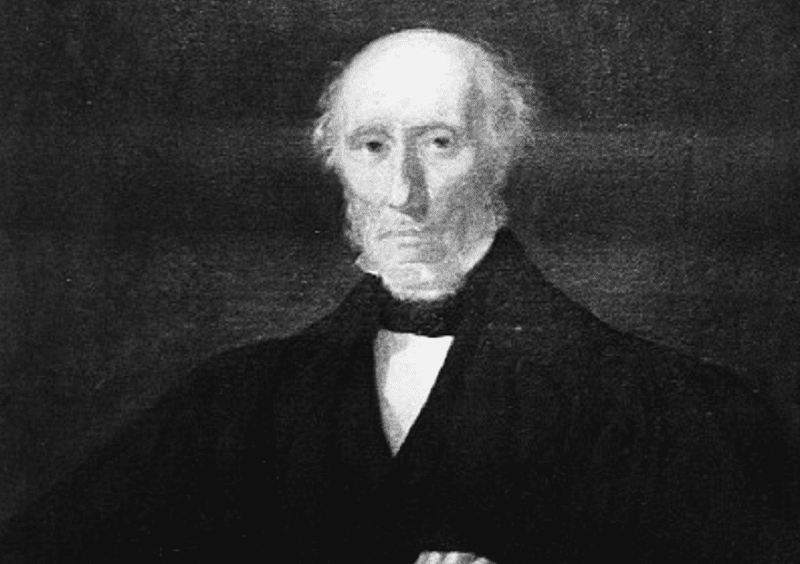
James was not formally educated as an architect. However, he had the opportunity to travel a lot from an early age and got a proper cultural education. The deep knowledge of the history of architecture became the reason for his interest and ability to design buildings. He learned a lot from his father and also studied engineering at Columbia College. It is worth noting that James entered it at the age of 12 and graduated in 1836. The master’s degree he got in three years.
Influence on architectural style
James Renwick Jr., like some of his contemporaries (Richard Upjohn and Alexander Jackson Davis), was an ardent supporter of the Gothic Revival style. All his activity was aimed at creating the dominant American style. It was Medieval style with massive tower structures that resemble castles and cathedrals.
The ability to successfully complete deals and satisfy the requests of wealthy clients made him a very rich person at a fairly young age. In addition, he was the owner of two steam yachts and possessed a huge collection of works of art.
Career after graduation
Upon completion of studies at Columbia College, his first work was for the Erie Railroad as a design engineer. The next job was at the Croton Aqueduct as a supervisor and assistant engineer.
The future world-famous architect changed the direction of his activities after winning the competition for the development of the project of buildings and structures. James received his first large order at the age of 25. It was a project of the Grace Episcopal Church in New York (the construction lasted from 1843 to 1846). It was a parish church, a part of the local Episcopal Diocese, located at 800-804 Broadway, on the corner of East 10th Street.
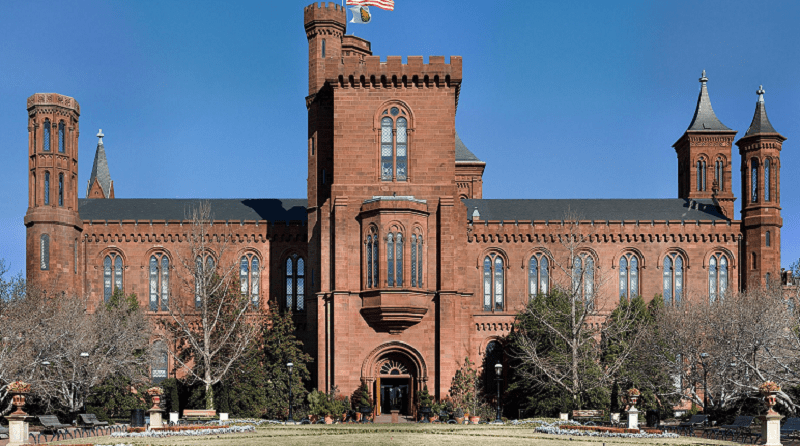
In 1846, Renwick Jr. became a winner with his project of the Smithsonian Institution. At the request of the Board of Regents, he designed it in the Romanesque style, using red sandstone from the Seneca Quarry as the main material.
After several successfully completed projects, James gained confidence in his own competence in the selected profession. He got orders for the creation of offices, various commercial buildings, hotels and residences for the most rich clients in New York, Staten Island and Newport, Rhode Island. To meet the deadline for numerous orders, James decided to hire several young architects, including John Wellborn Root and Bertram Goodhue. Both of them became recognized for their works and gained fame in their time.
The most outstanding creations
Renwick, Jr. worked in New York for most of his professional career.
His most famous creations include:
- Grace Church on Broadway (years of construction date from 1843 to 1846). Its appearance was first marked by the Gothic Revival style of the second variety
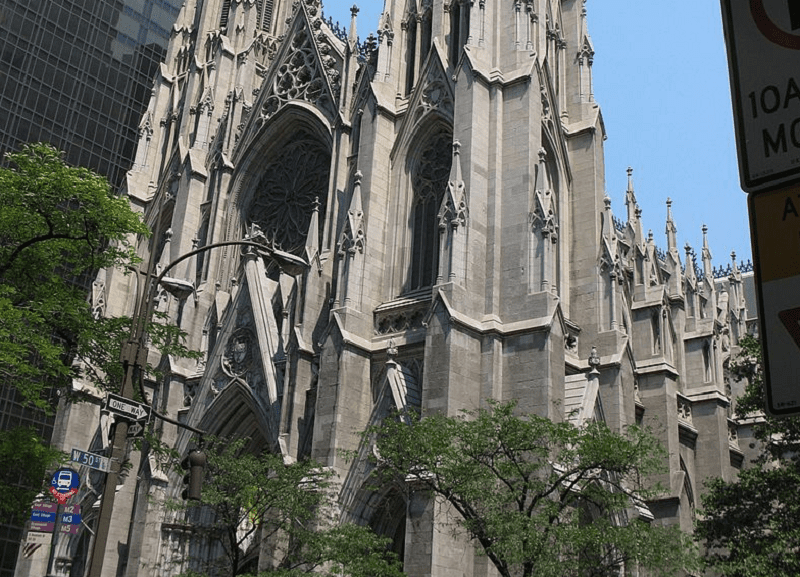
- St. Patrick’s Cathedral (built from 1858 to 1879). He revised the design of the influential building for US Catholics. He added an eclecticism after expanding his own knowledge of Continental Gothic during a trip to France in 1855. The exterior and interior of St. Patrick’s Cathedral used the styles of such famous buildings as York, Amiens, Reims, Cologne and Exeter Cathedrals, as well as Westminster Abbey. However, the final form of St. Patrick’s Cathedral eventually underwent many changes. Thus, the cathedral has lost the octagonal cruciform tower originally envisaged in the project
- The Smithsonian Institute or The Castle (1847-1855) was created in the style of the Second Empire. The building combined picturesque compositions of English, French and German styles with round arches and patterns
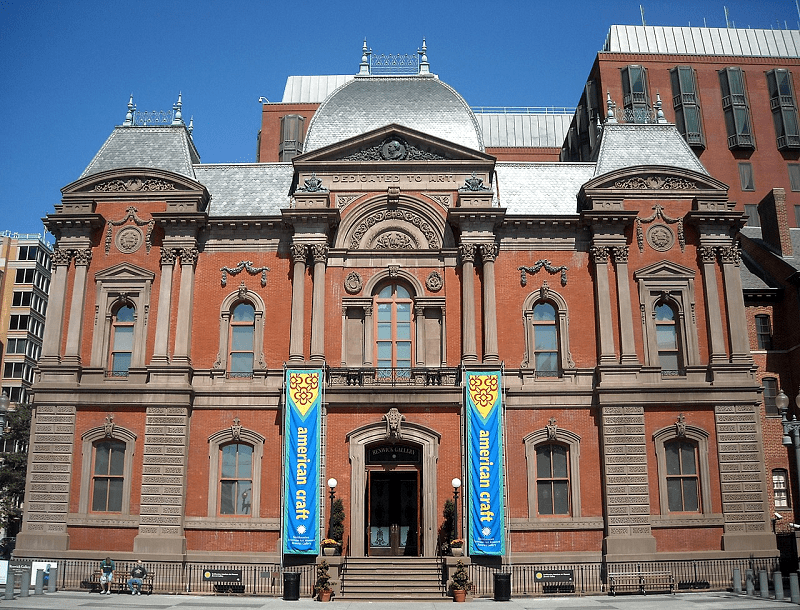
- Corcoran Gallery of Art (now Renwick). It was built from 1859 to 1871 in the style of the Second Empire. Later, it became the US Court of Claims. Brick and brown stone were used during construction and the building had good proportions. A distinctive feature of the exterior is the square dome, mansard roof and imitation decor. When designing it, James was inspired by the work of Jacques Lemercier (Louvre, Paris)
- the main building of Vassar College (created between 1861 and 1865) was built based on a simplified version of the Tuileries Palace in Paris and combined other styles of the Renaissance
- the Charity and Smallpox Hospitals on Roosevelt Island (created between 1858 and 1861) was recognized as an aesthetically unsuccessful project. Still, the Board of Governors had a different opinion. Renwick Jr. was inspired by the Tuileries building in Paris when creating the hospital project. During construction, gray stone quarried by prisoners was used. Crosses and lintels were of a lighter shade and the roof was covered with purple slate.
Death and legacy
After the death of James Renwick Jr. on June 23, 1895, the architect’s firm took the name Renwick, Aspinwall & Renwick. Later, Owen was added as a third partner (after Walter Owen joined it). Then, Tucker (in 1904) and it became Renwick, Aspinwall & Guard (late 1920s). The abbreviation of the organization underwent changes depending on the start/end of cooperation with one or another partner. Many of Renwick Jr.’s subordinates later became influential specialists. Bertram Goodhue and John Wellborn Root were such examples.
Renwick Jr. was buried in Green-Wood Cemetery in Brooklyn, next to his wife and father.