
This article is about a well-known American medical institution that not only provides quality treatment but also education. According to Newsweek, in 2023, the hospital ranked twenty-third among over 2,300 hospitals worldwide and was recognized as the best in America. Read about the establishment and development of Mount Sinai Hospital at i-manhattan.
Founding
Located between East 98th Street and East 103rd Street in Manhattan, it is one of the largest and oldest educational hospitals in the country.
Now, let’s learn about the establishment of this institution. It is important to note that in the 1850s, the rights of Jews in America were significantly suppressed, particularly regarding access to medical services. Therefore, Jewish philanthropist Sampson Simson decided to found a hospital to help the local Jewish community. The institution was originally named The Jews’ Hospital in the City of New York and was located on West 28th Street, between Seventh and Eighth Avenues.
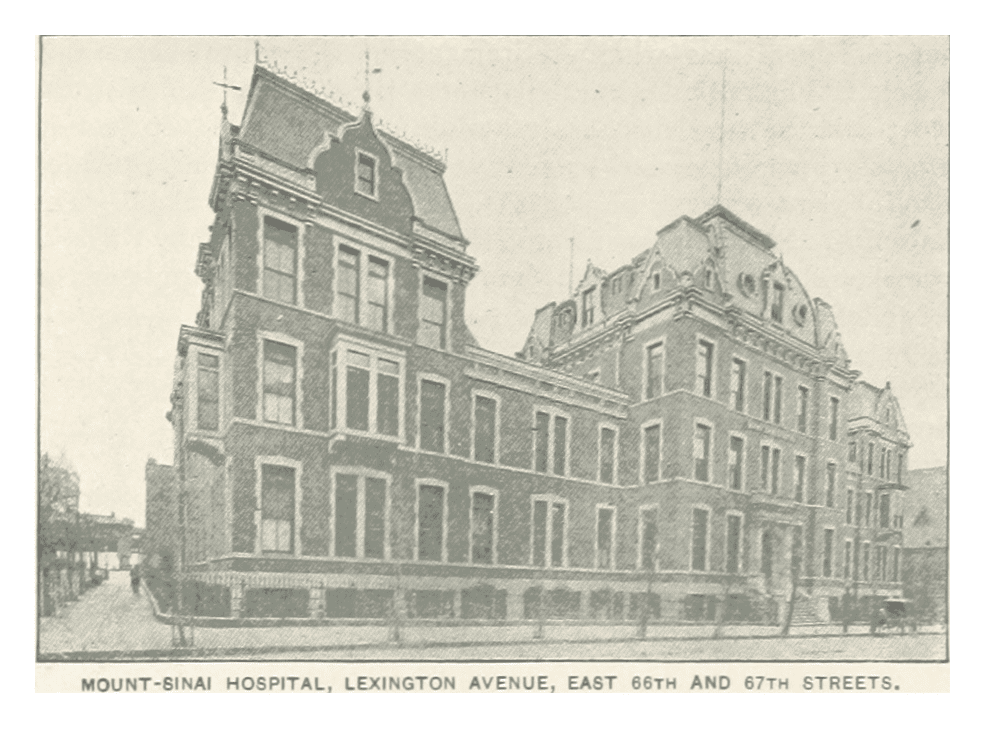
In addition to treating Jews, the hospital took care of wounded soldiers during the Civil War. Doctors were also required to serve in the military. A similar situation arose in 1863, as the physicians at Mount Sinai Hospital had to rescue victims of riots, which significantly exhausted the latter. In 1866, the institution received its modern name. By 1872, the medical facility relocated to a new and more spacious building on Lexington Avenue, situated between 66th and 67th Streets.
Further activities and development
After the move, the range of services increased. The hospital introduced pediatrics, neurology and dermatology units and began treating ear, eye and urogenital diseases.
In 1881, a nursing training school was established at Mount Sinai Hospital by Alma Hendricks and several other women. Initially called the Mount Sinai Hospital Training School for Nurses, it later became known as the Mount Sinai Hospital School of Nursing. The school closed in 1971 but was reopened in 2013 under the name Mount Sinai Phillips School of Nursing or PSON for short.
The hospital was constantly developing. At the beginning of the 20th century, it had made significant advancements in blood transfusion. During this period, the first endotracheal anesthesia machine was introduced here. Soon, Mount Sinai Hospital evolved into a full-service medical institution that treated complex diseases. As a result, it required even greater expansion, leading to the hospital’s relocation to Fifth Avenue at 100th Street in 1904.
The hospital was an active participant during the period of the two world wars. In World War I, about ninety staff members worked in medical units. In World War II, around nine hundred hospital employees provided medical care. It is also worth noting that in wartime, Mount Sinai Hospital became the first facility to train nurses, aiming to address their shortage in the United States.
In 1963, in the post-war period, the Mount Sinai School of Medicine was officially opened at the hospital. The first students were admitted in 1968. An important medical breakthrough at Mount Sinai Hospital during this time is worthy of special notice. The institution made substantial contributions to gene therapy, immunotherapy, cardiology, organ transplantation, cancer treatment and minimally invasive surgery. Additionally, the clinic performed the first blood transfusion and developed a method for injecting radioactive seeds into the prostate for cancer treatment.
In the 21st century, the institution faced challenging times, but the situation began to gradually improve in 2002. Today, it continues to grow not only in the field of medical services but also in education.