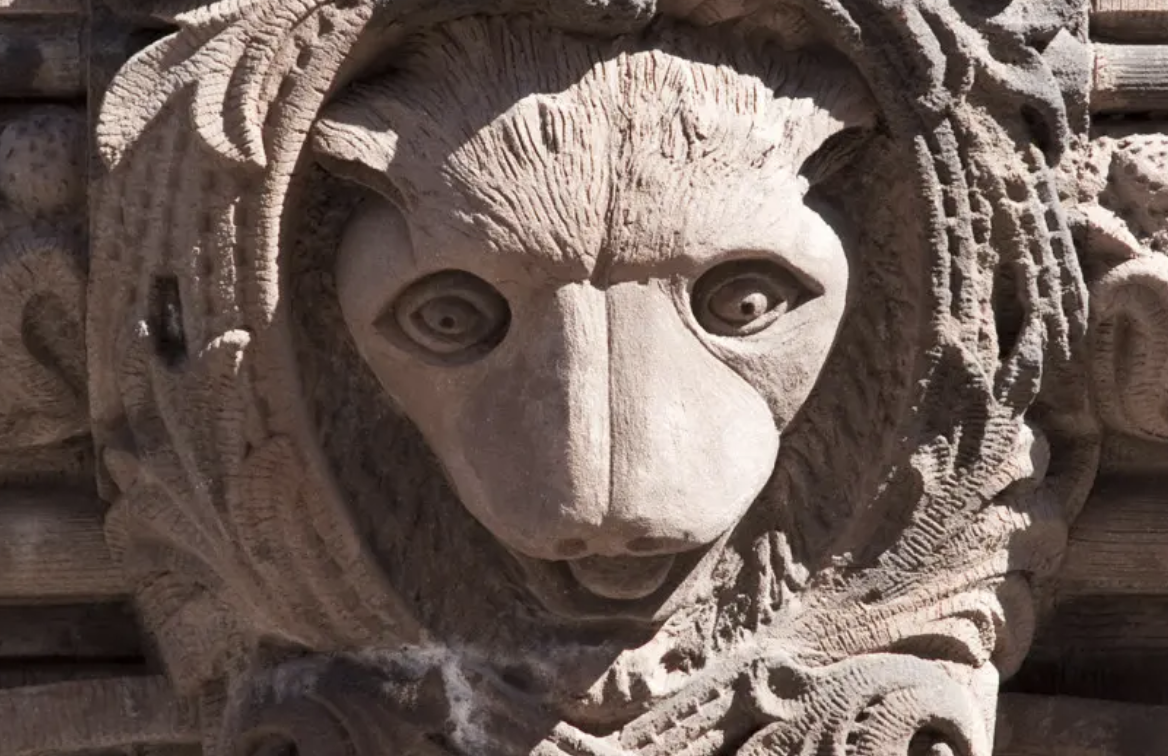

Wandering through New York, our eyes naturally drift toward soaring glass skyscrapers. Yet the city’s deepest secrets are etched into Manhattan’s historic masonry. These stone facades form an open book—a public language the city has spoken for over a century. Behind heavy limestone and rugged granite lie stories of staggering wealth, imperial ambition, and the subtle wit of anonymous artisans. This guide from i-manhattan.com reveals how to decipher the layered visual codes of early 20th-century architecture: from classical deities guarding bank vaults to whimsical beasts perched atop residential buildings.
The Language of Stone: How Limestone and Marble Became Symbols of Power and Eternity
In Manhattan’s monumental architecture, the choice of building material was never accidental or purely utilitarian. When architects designed new banks, corporate headquarters, or train terminals, they turned to stone: pale Indiana limestone, pristine marble, austere granite, or warm brownstone. This choice spoke volumes about status. Stone signaled unshakeable wealth, absolute authority, and a claim to permanence. Masterful carvings transformed flat masonry into a rich visual narrative that passersby were meant to read from the ground up—from the heavy rusticated base to the ornate cornice.
Over time, Indiana limestone became the gold standard of New York prestige. It offered the perfect compromise: soft enough for intricate detailing, yet durable and dignified enough to project monumental, almost imperial weight. The stone was chosen for the era’s defining landmarks—all built to broadcast the resilience of American capital—from the grand Beaux-Arts arches of Grand Central Terminal to the soaring Art Deco lines of the Empire State Building.
In other words, before an onlooker could even process an exquisite bas-relief or a classical column, the material itself had already made its statement. The stone declared that the structure was built to endure for centuries and that the institution inside was as solid as rock. This provided the ideal backdrop for more elaborate visual allegories, through which the financial elite cast themselves as the pillars of modern civilization.
Temples of Capital: Classical Allegories and Corporate Iconography
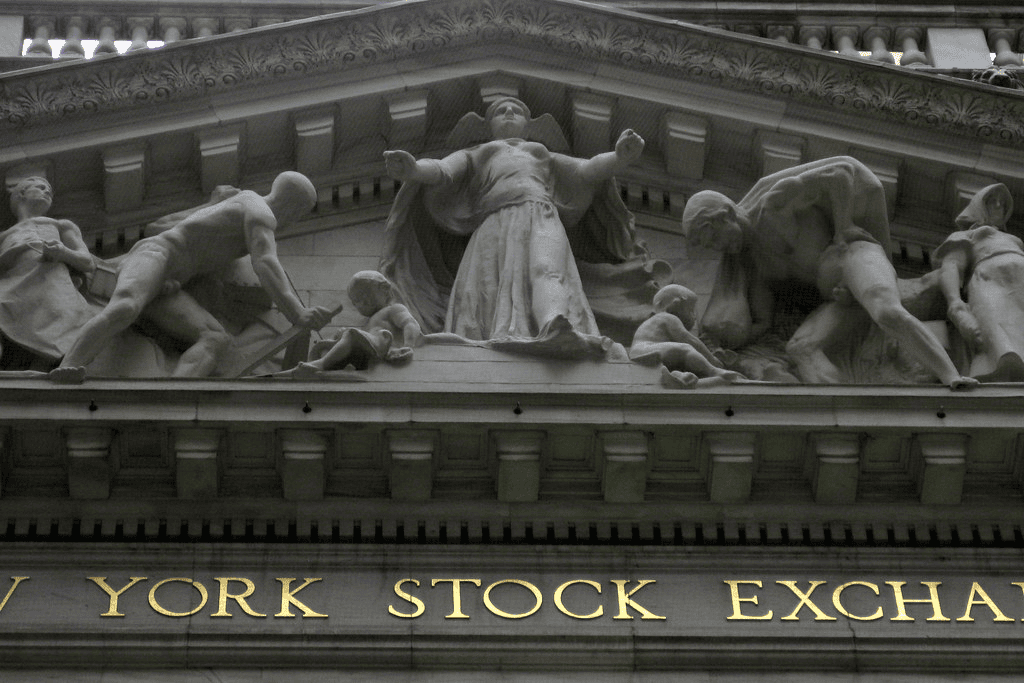
To project legitimacy, stability, and a moral mandate to shape the world, early 20th-century financial institutions and civic agencies leaned into the timeless vocabulary of classical antiquity. Nowhere is this transformation more evident than at the New York Stock Exchange, completed in 1903 to designs by George B. Post.
Its neoclassical facade of white Georgia marble evokes a Roman temple. The central message crowns the monumental pediment, featuring John Quincy Adams Ward’s sculptural group, “Integrity Protecting the Works of Man.” The architect deliberately chiseled into stone the premise that market integrity and financial prudence were the sacred civic virtues of the modern age.
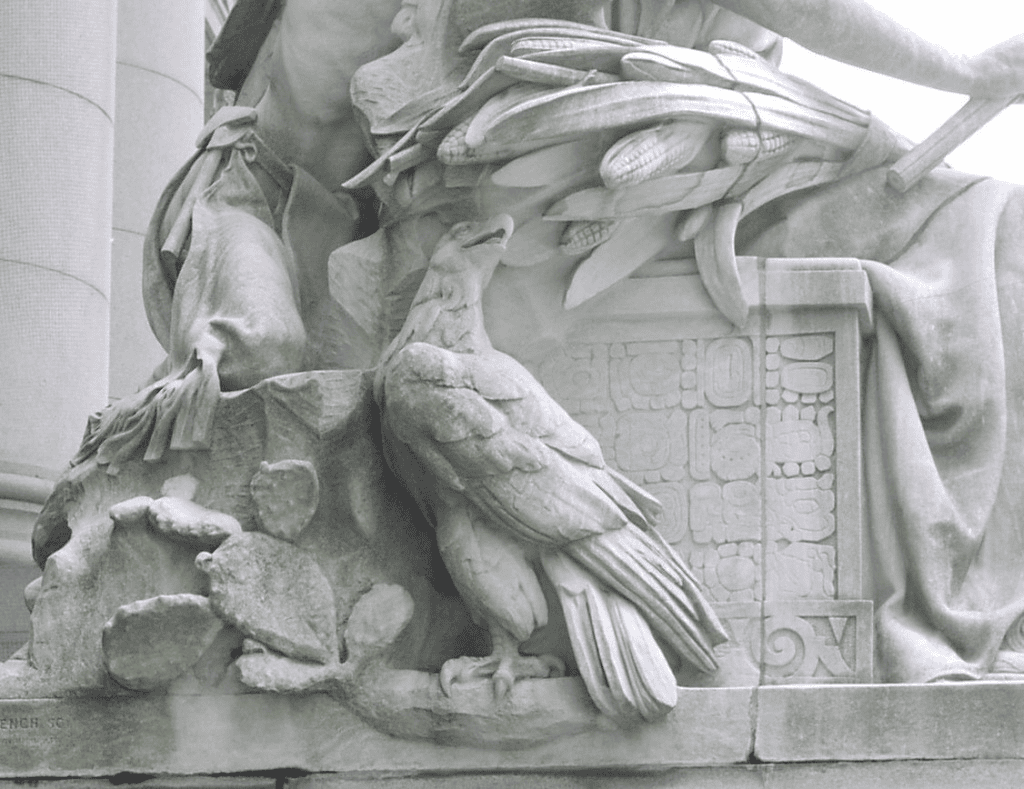
Equally revealing is the Alexander Hamilton U.S. Custom House at Bowling Green—a veritable monument to New York’s emergence as an imperial port and a hub of global commerce. The focal points here are Daniel Chester French’s monumental limestone sculptures, the “Four Continents.” Looking upward, one can read an entire cosmic hierarchy: statues of great seafaring empires crown the colonnade, Mercury (the god of commerce) hides in the column capitals, while American eagles, Great Seals of the United States, and keystones carved with heads representing the peoples of the world punctuate the facade.
Before long, private corporate giants picked up the baton from civic and financial institutions, carving out their own corporate mythology in stone. At the Standard Oil Building, constructed from Indiana limestone in the Neo-Renaissance style, the exterior unfolds an elaborate tribute to the Rockefeller oil empire.
Classical gods give way to torches and lamps symbolizing kerosene and oil, while the company’s global reach is depicted through twin terrestrial globes gripped by an eagle and a winged dragon. At the summit, a monumental brazier modeled after the ancient Mausoleum at Halicarnassus served as a beacon of corporate dominion for ships steaming into New York Harbor.
The pinnacle of this corporate apotheosis is 70 Pine Street. Here, architects blended limestone, granite, and gneiss with stylized solar motifs and the company’s signature triangular logo. The building’s most astonishing detail is carved directly into its entrance portals: a miniature replica of the skyscraper itself, poised above the threshold like a Madonna or saint in a Gothic niche, symbolically blessing the crowds below. In motifs like these, capital became a modern religion, and skyscrapers were erected as its cathedrals.
Folk Art of Manhattan: Gargoyles, Portraits, and Masons’ Marks
While banks and corporate trusts used stone to project sheer institutional might, residential Manhattan told an entirely different story. The decades between the Civil War and World War I marked a golden age of architectural stone carving. This artistry came from thousands of anonymous immigrant stonecarvers arriving from Europe, Asia, and Latin America. Blueprints often included little more than a generic note reading “carving here,” giving master artisans free rein to leave their personal touch.
Across Lower East Side tenements and Upper West Side row houses, stone menageries and portrait galleries flourished. Lions, playful grotesques, and sometimes real human faces—such as the landlord’s children—peered down from lintels and cornices. Yet this artisanal heritage remains remarkably fragile. In 1980, the exquisite Art Deco bas-reliefs of dancing women adorning the Bonwit Teller flagship on Fifth Avenue were notoriously destroyed to clear the site for Trump Tower.
Gargoyles are another iconic feature, clustering in surprising numbers along the Upper West Side. Unlike their medieval European forebears, they were not meant to ward off evil spirits; instead, they served as a playful architectural flourish, lending buildings prestige and a hint of Gothic whimsy. Perhaps the most intimate trace of the builders themselves can be found in the personal stonemasons’ marks—initials, stars, and cryptic symbols—chiseled directly into the stone arches of the Park Avenue Viaduct.
Living Gothic and Modern Prophecies: The Cathedral of Saint John the Divine
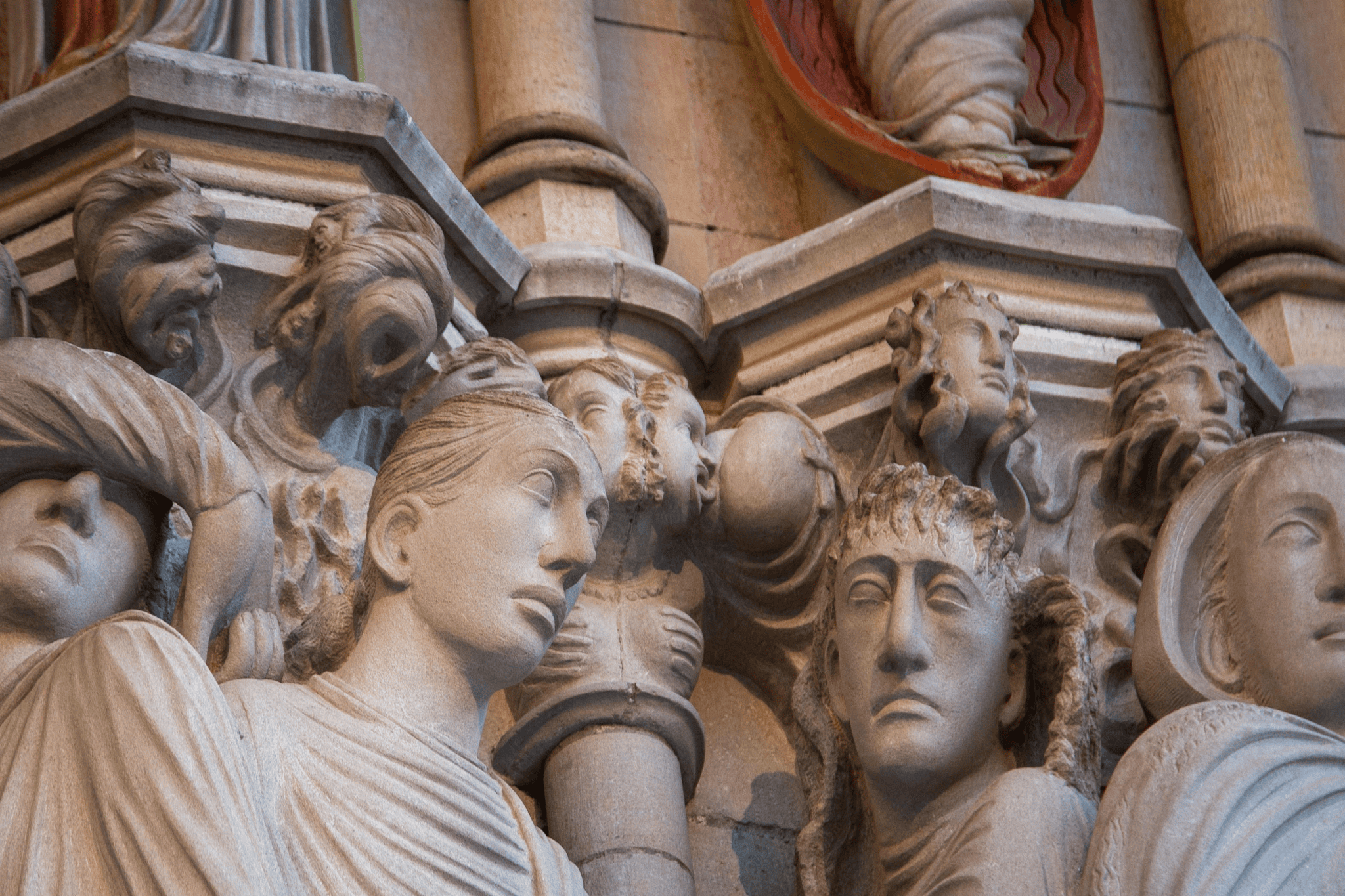
Symbolic stone carving is by no means confined to centuries past. A striking contemporary example stands at the Cathedral of Saint John the Divine in Morningside Heights. Its western entrance, known as the Portal of Paradise, was carved between the late 1980s and 1997 by a team of artisans led by sculptor Simon Verity. Adopting a classic Renaissance technique, they gave biblical prophets and saints the likenesses of real New Yorkers, transforming the Gothic portal into a living chronicle of the local community.
What catches visitors most by surprise, however, lies carved beneath the feet of these sacred figures. In 1989, carver Joseph Kincannon rendered a series of apocalyptic scenes depicting modern New York as a falling Jerusalem. Etched into the limestone are the Manhattan skyline, the Twin Towers of the World Trade Center collapsing, and a nuclear mushroom cloud. After September 11, 2001, the tableau took on the aura of an eerie premonition—though sculpted beneath the destruction is a message of hope: Gothic arches signifying life rising from the ashes.
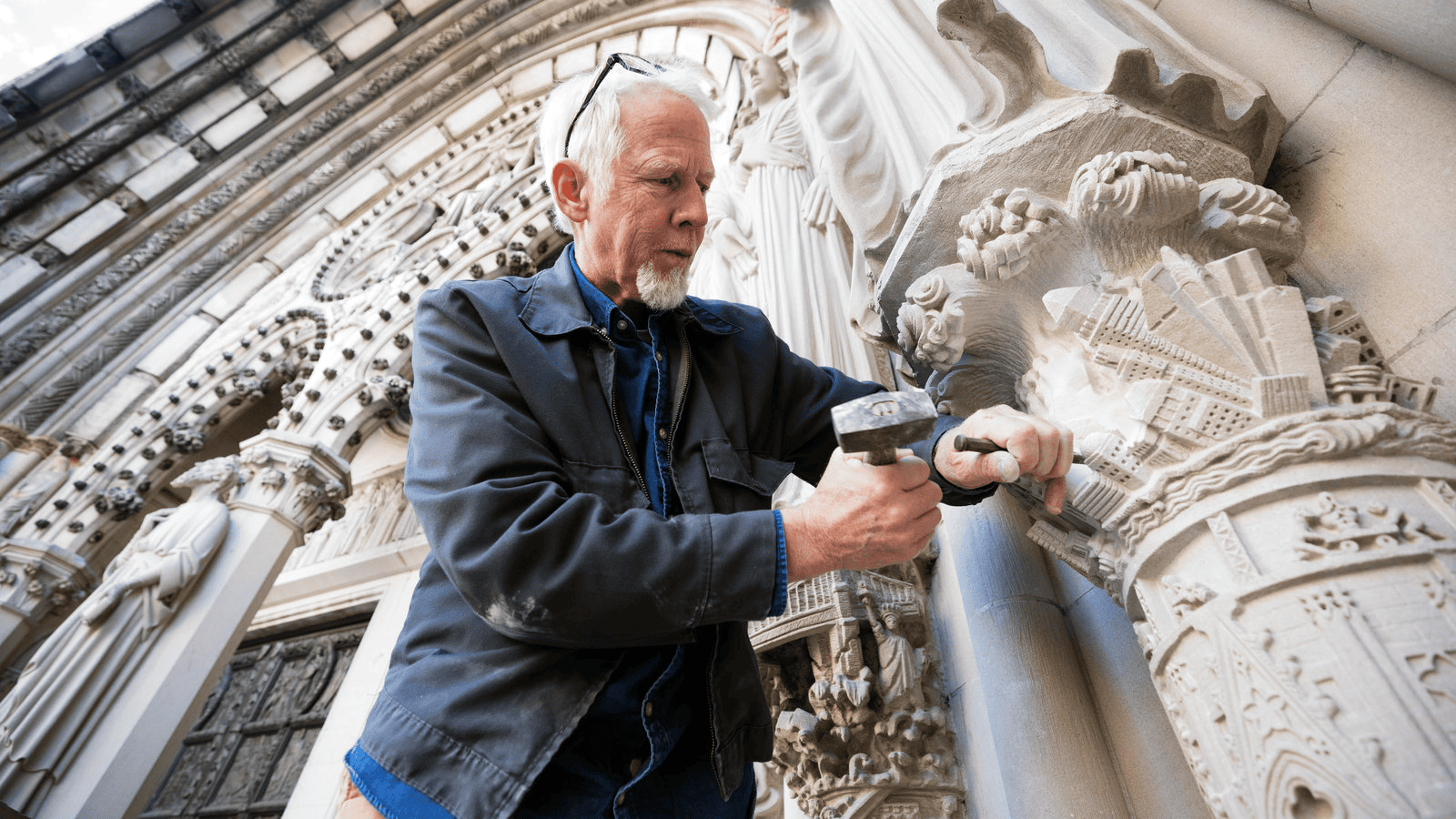
The photo above shows Joseph Kincannon beside his 1989–90 carving; the miniature towers were subsequently restored in 2019 following an act of vandalism. Works like these form an indispensable part of Manhattan’s cultural heritage, alongside the storied architecture of Wall Street.
How can you start deciphering Manhattan’s stone stories on your own? Begin with the big picture: heavy limestone or marble instantly reveals the ambitions of the financial elite, while classical columns signal an attempt to channel the dignity of an ancient temple. Next, look for corporate logos and allegorical motifs, and finally, zoom in on the eaves, lintels, and arches to discover the whimsical handiwork of individual carvers.