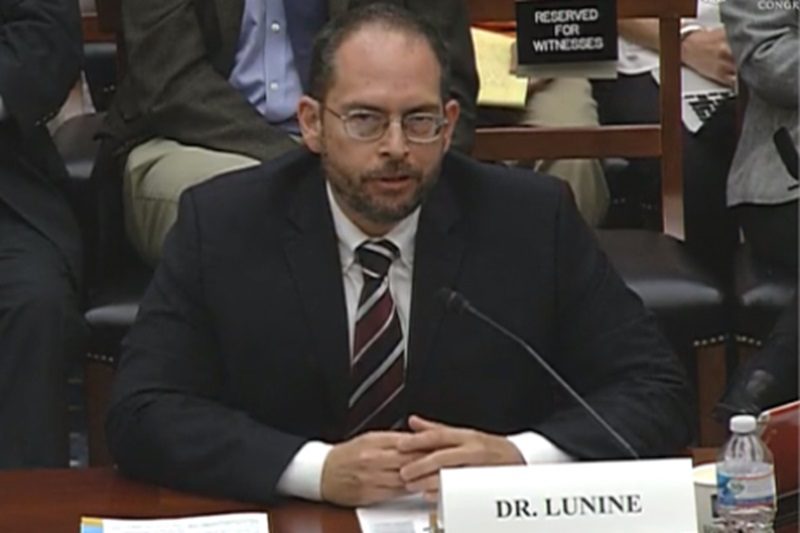

Jonathan Irving Lunin is a prominent planetologist, physicist and the David C. Duncan Professor in the Physical Sciences. He teaches at Cornell University and also serves there as the head of the Department of Astronomy. In his work, Lunin focuses on the study of planet formation, its evolution and habitability. He was raised in a Jewish family but later converted to Catholicism and helped to establish the Society of Catholic Scientists. Let’s learn more about the life and professional activities of the famous scientist J.I. Lunin, who was born in Manhattan, one of the five boroughs of New York at i-manhattan.
Astronomy captivated the future scientist for life
Physicist Jonathan Irving Lunin gained fame for his research in astronomy and planetology. He has made a substantial and diverse contribution to science. Lunin is a professor of physics at Cornell University and also a research associate at Lawrence Livermore National Laboratory. He is a member of the National Academy of Sciences and the Royal Society of London.
One of Lunin’s main research areas is the study of atmospheres and compositions of various planets in our solar system. He has actively taken part in missions to other planets, such as Saturn and Jupiter. He was particularly influential in understanding the composition of Saturn’s moons and their potential habitability.
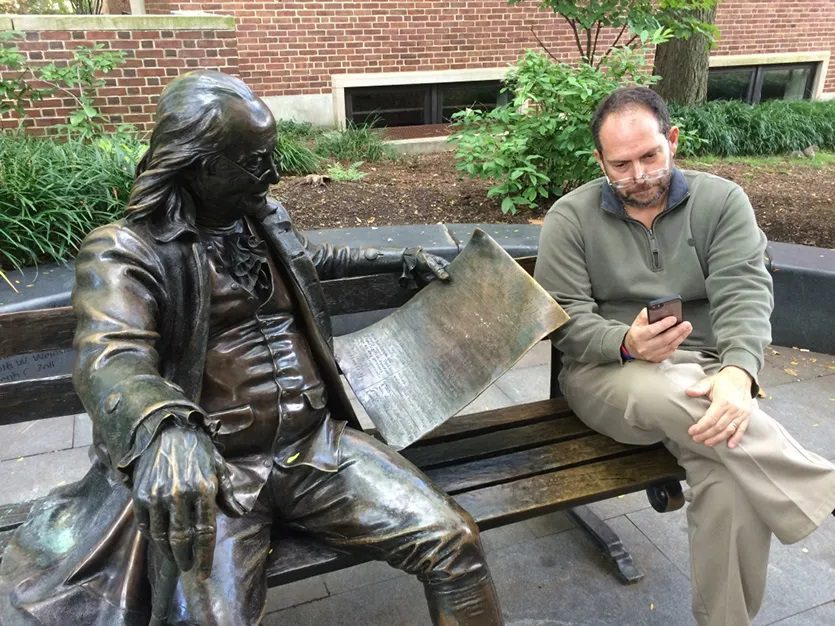
Photo source: https://science.nasa.gov/
Lunin is also known for his theoretical research on the possibility of extraterrestrial life. His research addresses questions about the conditions necessary for life to develop on other planets, including exoplanets in other star systems.
In addition to his scientific activities, Lunin publishes articles and books aimed at a broad audience, with the goal of popularizing astronomy and scientific knowledge about the universe.
Achievements and awards of Jonathan I. Lunin
In 1980, Lunin received a Bachelor’s degree in Physics and Astronomy from the University of Rochester. In 1983, he earned a Master’s degree and in 1985, he obtained a PhD in Planetology from Caltech.
Additionally, Lunin is a member of the National Academy of Sciences, the American Association for the Advancement of Science and the American Geographical Union. He is also in the ranks of the International Academy of Astronautics, which awarded him its Basic Science Award in 2009.
Lunin is the D. Baltimore Distinguished Visiting Scientist at NASA’s Jet Propulsion Laboratory. He is an interdisciplinary scientist on the Cassini mission to Saturn and the James Webb Space Telescope. He also participated in the investigation of the Juno mission, launched in 2011 to Jupiter. He is the principal investigator of an astrobiological mission to Enceladus called Enceladus Life Finder.

Photo source: https://www.cornell.edu/
In 2015, the EU presented him with the Jean Dominique Cassini Medal in the field of Earth sciences. He wrote about 400 scientific papers, as well as the books “Astrobiology: A Multidisciplinary Approach” (2005) and “Earth: Evolution of a Habitable World” (2013).
Biography of the future physicist, professor of physical sciences
Jonathan Irving Lunin was born on June 26, 1959, in Manhattan, USA. Little is known about his childhood, but he grew up in a family that supported interests in science and research. Apparently, he showed an interest in astronomy and physics from an early age.
After completing his basic education, Lunin enrolled in university to study physics and astronomy. He proved himself a talented researcher and continued his education. He earned a doctoral degree in physics or astronomy (exact details may vary in different sources).
Since then, Lunin has become a well-known and recognized expert in the fields of planetology and astronomy. Throughout his career, he worked at major universities and research centers and took an active part in international scientific missions and projects.
Today, Jonathan Irving Lunin is a prominent scientist and teacher whose research and discoveries greatly help us to understand the universe and its possibilities.
Lecture on Georges Henri Joseph Édouard Lemaître
Lunin has published over 380 scientific works and has also delivered a lecture on Georges Lemaître. The latter is associated with Lunin due to their convergence of interests in research and studies in the fields of astronomy and planetary science. G. Lemaître, a renowned French astronomer and planetary scientist, is one of the leading experts in the study of planetary atmospheres. His works are widely studied and valued in the scientific community.
Jonathan Lunin, for his part, also actively contributes to the study of planets and their atmospheres. He conducted research based on the knowledge of the aforementioned scientist and published scientific articles and reports. Their work has helped us learn more about the planets and the conditions on other celestial bodies.
Thus, these scientists are connected because of their activities in the fields of cosmology and astrophysics, as well as their significant contributions to the study of astronomy and planetary science.
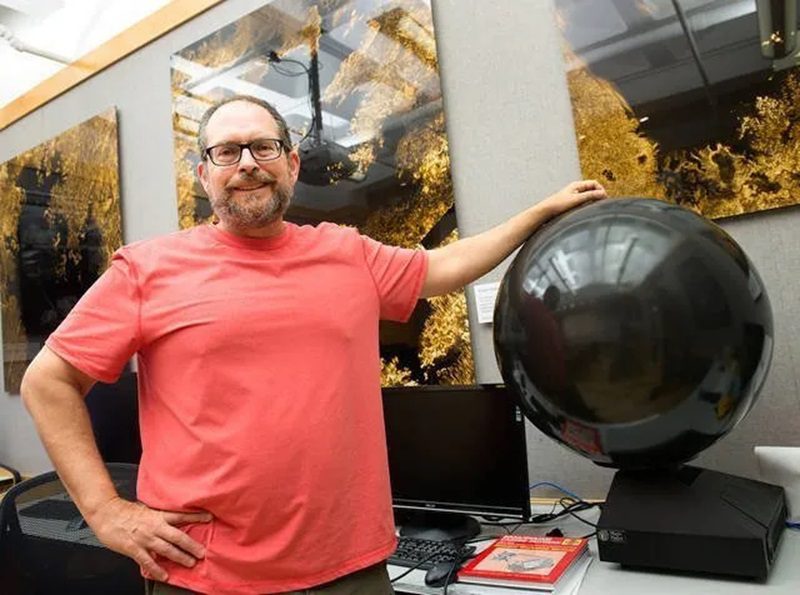
Photo source: https://catholiccourier.com/
Physicist Lemaître became famous as an outstanding scientist in the fields of astronomy and cosmology. One of his major achievements is the development of the Big Bang theory, which became the foundation for modern cosmology. Lemaître was one of the first to propose the idea of the expansion of the universe from a dense, hot initial state, which later came to be known as the Big Bang.
In addition, Lemaître also contributed to astronomy by studying the cosmic background radiation, which is a remnant from the very beginning of the universe. His research and theories became key to understanding the structure and evolution of the universe.
Despite being primarily a researcher, Lemaître was also a Catholic priest. His scientific work was widely recognized, and he became one of the important figures in the development of modern astronomy and cosmology.
In 1927, Lemaître published his important paper on the expanding universe. His theory, which explained how matter fills the expanding space, integrated and improved upon the ideas of Einstein and de Sitter in cosmology. It was directly confirmed by astronomical observations and did not require the introduction of an additional cosmological constant. According to his model, the speed at which galaxies move away from each other should be proportional to the distance between them. To develop this theory, Lemaître used available astronomical data on distances between galaxies and their redshifts.
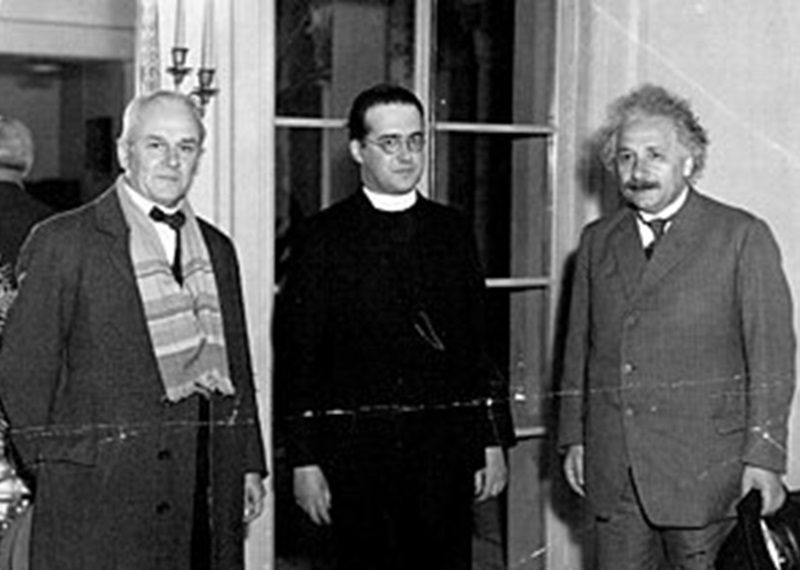
Robert Millikan, Lemaitre, and Alfred Einstein after Lemaitre’s lecture at Caltech Institute in January 1933. Photo source: https://en.wikipedia.org/
Although it is often difficult to accurately attribute a discoveriy to a specific scientist, in the case of Lemaître, it is particularly important to note this. Even with some awards he received during his lifetime, his contribution to science remains undervalued. It is especially important to consider his religious identity when speaking of his achievements. Recognizing his name in the history of astronomy through the International Astronomical Union’s adoption of the term Hubble-Lemaître Law would be beneficial for both religious and atheist scientists. For the first ones, it would emphasize the possibility of combining science and faith, expanding societal arguments in this direction. The latter could understand that Lemaître was not always fairly perceived as a scientist, both during his life and after his death, due to his religious beliefs.