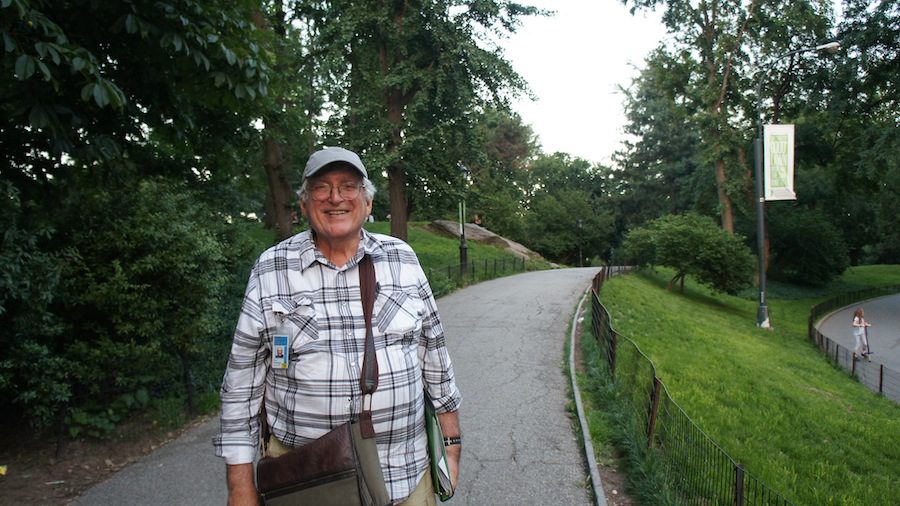

Sidney Horenstein was a geologist, educator, ecologist, and researcher renowned across America. His popular books, guided tours, and deep affection for New York earned him fame as the defender of the bedrock the city is built upon. This man made a significant contribution to the development of geology. We’ll delve deeper into his life and work on i-manhattan.com.
A Childhood Passion for Exploration
Sidney Horenstein was born in Manhattan on November 17, 1936. His father, Morris, was a barber, and his mother, Mary, worked in a factory. The family later moved to Queens. As a child, Sidney bought army binoculars to study the sky, and every evening, the boy enthusiastically watched the stars. After graduating from Long Island high school, he enrolled in Hunter College in 1958, where he soon earned his bachelor’s degree. For four decades, Sidney lectured and conducted tours for the American Museum of Natural History, becoming an honorary environmental educator in 2004. Horenstein also led expeditions around the world as part of the Smithsonian Journeys project under the auspices of the Smithsonian Institution.
Studying Stones and Fossils

Sidney was a fine geologist and the coordinator of public environmental programs at the American Museum of Natural History. Additionally, he worked as a lecturer at Hunter College in New York City and was an expert on the tectonic cataclysms that shaped what remains of New York’s natural landscape. While other geologists preferred to conduct geological exploration in pristine environments, Horenstein called New York the “world’s greatest geological mecca” and a “geological smorgasbord.” He had many reasons for this perspective.
In a 1991 interview with The New York Times, Sidney noted that all of geology is concentrated in New York. By walking along 5th and 6th Streets, you could reconstruct the history of the world through the stones used in construction. Horenstein always referred to himself as a “stone detective” and took pleasure in identifying the fossils adorning the stone facades of skyscrapers and the walls of public restrooms, as well as the locations where the stone was quarried before it was brought to New York City building sites.
Horenstein would examine colonial coral fossils through a handheld magnifier in the doorway of Saks Fifth Avenue while unsuspecting shoppers hurried past. Every discovery sparked no less enthusiasm. For example, the Missourian brachiopods in the Brooklyn Municipal Building, a white spot that turned out to be an 8-inch fossilized snail and Indiana limestone in the lobby of the Comcast Building at Rockefeller Center, or the Cretaceous mollusks in the Western Union Building in Lower Manhattan.
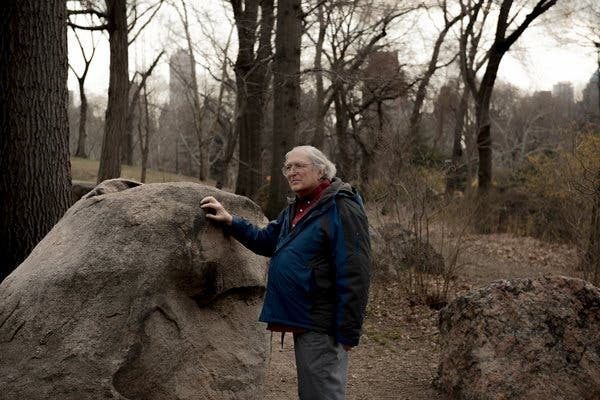
In a subsequent interview in 1978, the geologist said he loved studying fossils because a careful examination reveals a part of life’s evolution. Sidney captivated his audience with various stories from his practice. For instance, Horenstein claimed that rocks could serve as landmarks for those lost in Central Park, especially at night when lights make observing constellations difficult. He also explained why the stones in the park are quite smooth, leading to natural rock slides—the reason was millennia of glacial abrasion.
The geologist assured people that, contrary to urban legend, the limestone cladding the main waiting room of Grand Central Terminal does not emit excessive radiation. On average, people receive 360 millibars per year from TVs, smoke detectors, and cosmic rays, while full-time terminal employees receive about 120 millibars from the walls.
Horenstein calmed those worried that the growing number of downtown skyscrapers might cause Lower Manhattan to sink. Not at all, he explained, because the stone excavated for their foundations actually weighs more than the hollow buildings themselves.
Successful Author, Beloved Husband, Caring Father

Sidney Horenstein authored a number of books, the most popular of which include Concrete Jungle: New York City Our Last Best Hope for a Sustainable Future (2007) and A Geologist Looks at Manhattan: A Guide to 100 Fascinating Sites (2014).
Sidney was a beloved husband and a caring father. In 1967, he married Marcia Lichtenstein. They had two daughters, Merrill and Jennifer, who gave them four grandchildren. The family lived for a long time in the Inwood neighbourhood of Upper Manhattan, whose terrain, approximately 445 million years old, gifted the geologist with an unusually long perspective.
Once, during one of his numerous tours of the enormous Manhattan West construction project excavations above the rail lines near Penn Station, Sidney described a folded layer of gray schist intermixed with white pegmatite. He noted that the unique pattern formed when mud on the seabed was shaped by the intense collision of the plates that make up the Earth’s crust.
Sidney died on December 5, 2018, at the age of 82. Many of Horenstein’s colleagues note that he loved his work and New York with all his heart, thoroughly studying its rocks and soil.