
Nikola Tesla was a brilliant engineer, physicist, and a pioneering inventor in electrical and radio engineering. This visionary made an immense contribution to the development of electrical engineering and became a world-renowned figure. Remarkably, almost all of his creative work took place in Manhattan. We delve deeper into Tesla’s life and work on i-manhattan.com.
Moving to New York
Born in 1856 to a Serbian family in what is now Croatia, Nikola Tesla was convinced, even as a college student, that a more efficient electric motor could be developed—one that would run on alternating current (AC) rather than direct current (DC). Eager to gain the practical knowledge needed to perfect his invention, Nikola worked for Edison’s companies in Budapest and Paris. Impressed by his troubleshooting skills in electrical lighting systems, Edison’s managers transferred Tesla to New York.
Nikola arrived in New York in June 1884. Having lived in Budapest and Paris, he was initially somewhat taken aback by the city’s rough edges. However, he didn’t dwell on the contrasts, as he soon began working at Edison’s machine works on Henry Street in the Lower East Side. There, Nikola drafted designs for an arc lighting system. He also continued to refine his ideas for the AC motor. Tesla believed his arc lighting system would be valuable to Edison’s organization and that he would be generously compensated for his work. When that didn’t happen, Nikola left in frustration and found new backers in Rahway, New Jersey. They helped him patent and build his own arc lighting system. Yet, as soon as the entrepreneurs launched the lighting system and made a substantial profit, they fired Tesla. Left penniless, he returned to New York and started digging trenches for the cables that connected the Western Union Telegraph Company headquarters to the stock and commodity exchanges.
By sheer chance, Tesla caught the attention of Alfred Brown, the foreman overseeing the work. Brown took a liking to the young man and introduced him to Charles Peck, a lawyer. Always on the lookout for a new high-tech venture, Peck and Brown decided to support Tesla in 1886.
The Founding of Tesla Inc. and the AC Motor Breakthrough
To establish Tesla Inc., Brown and Peck rented a laboratory space at 89 Liberty Street in the Financial District. The Globe Stationery & Printing Company occupied the ground floor, and Tesla rented the room upstairs, furnished only with a workbench, a stove, and a generator. To power the generator, Peck and Brown struck a deal with the printing company. During the day, the Globe Stationery & Printing Company used its steam engine to run the printing presses, and at night, it shared the electricity with Tesla Inc.
It was on Liberty Street that Tesla quickly perfected his AC motor by feeding it multiple out-of-phase currents to create a rotating magnetic field. Tesla patented this groundbreaking idea almost immediately, and Peck sold the patents to George Westinghouse.
To put his motor into production, Tesla briefly went to Pittsburgh, working with Westinghouse engineers. But he returned to Manhattan in 1889. Upon learning that Heinrich Hertz had discovered radio waves, Nikola rented a new laboratory on Grand Street. There, he refined the high-voltage, high-frequency transformer that is now known as the Tesla Coil.
To show how his high-frequency coil could be used for wireless lighting, Nikola lectured at the American Institute of Electrical Engineers’ spring meeting in 1891. He also staged a captivating demonstration. Two large zinc sheets were suspended from the ceiling and connected to the Tesla coil. Dimming the lights, Nikola took a long gas-filled tube in each hand and stood between the two sheets. As he waved the thin tubes, they glowed, charged by the electric field created between the plates.
The lecture at Columbia University cemented Tesla’s position as a leading inventor in electricity, a feat achieved just a few years after arriving in New York. To bolster his popularity, Tesla moved uptown. He chose the Gerlach Hotel on 27th Street for his residence—a grand 11-story building complete with elevators, electric lighting, and luxurious dining halls. Tesla also dined at Manhattan’s most fashionable restaurant, Delmonico’s on Madison Square, where New York’s finest chefs prepared his favorite dishes.
However, the most crucial location for the inventor became his new laboratory on 5th Avenue, where he leased the entire fourth floor of a factory building. There, Nikola experimented with wireless lighting, hosting demonstrations for friends, including the architect Stanford White.
Lost in a Night, Then Reborn
In 1895, a fire destroyed Tesla’s laboratory, and he lost everything in a single night. The fruits of 50 years of relentless work and research went up in smoke. The machines he had painstakingly refined were reduced to shapeless objects, and the vessels holding the results of meticulous experiments turned into piles of shards.
This event devastated Tesla, plunging him into a severe depression. Dejected and broken, Nikola, one of the world’s foremost electrical minds, retreated to his room at the Gerlach Hotel and became bedridden. His friends rallied around him, providing the support he needed to carry on. In July 1895, Tesla rented a new laboratory on Houston Street and got back to work. There, Nikola researched X-rays and built a remarkable radio-controlled boat, but his primary interest was developing a system to transmit electrical power globally without wires. To achieve wireless power transmission, Tesla began experimenting with increasing the power of his transmitter, soon generating sparks 30 feet long.
Although Tesla succeeded in creating powerful currents on Houston Street, he couldn’t figure out how they propagated through the Earth’s crust. This was because Manhattan’s numerous electrical systems—telegraph, telephone, lighting, and transportation—created too much interference. As a result, Tesla moved to Colorado Springs for eight months in 1899, where he built a large Magnifying Transmitter. It sent enough current through the earth to light up bulbs a mile away. Satisfied with these results, Tesla returned to New York in triumph, taking up new quarters at the Waldorf Astoria Hotel. He also began attracting investors for his wireless energy project and met with J.P. Morgan.
New Investments
Morgan soon invested \$150,000 in Tesla’s wireless electrical system, and Nikola built the Wardenclyffe Tower on Long Island. He commissioned Stanford White to design the 187-foot tower. Beneath it, Tesla drilled a 120-foot well to pump electricity into the earth, which he believed would transmit to the other side of the planet.
However, just as Nikola completed the tower, Guglielmo Marconi scooped him. In the winter of 1901, Marconi announced the transmission of a signal from England to Newfoundland. It was Marconi, not Tesla, who became the new radio wunderkind.
In response, Tesla proposed to Morgan to manufacture receivers that could pick up news, telephone messages, and telegrams from Wardenclyffe, but the financier refused to commit additional funds. Meanwhile, Nikola discovered how complex it was to pump oscillating currents into the earth. Constrained by his inability to reconcile physical reality with what he clearly envisioned, Tesla suffered a nervous breakdown in 1905.
Final Years
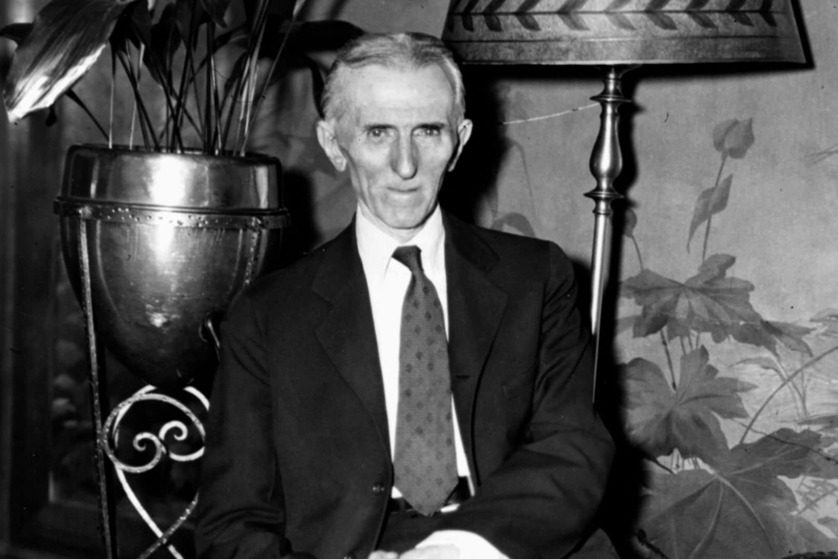
For the next 35 years, Nikola Tesla worked on several other inventions, including a compact bladeless steam turbine. Significantly, he intended to use it in aircraft and automobiles. To attract investors, Nikola first set up offices in the Metropolitan Life Tower and then in the Woolworth Building, which were the tallest in Manhattan at the time. As the inventor’s financial situation worsened, he moved to a more modest office on 40th Street. During his decades in Manhattan, Tesla lived in hotels, and when he could no longer pay his bills, he had to move from one to another. Eventually, he settled at the New Yorker Hotel, where the staff described him as having an energetic temperament.
In 1937, while on his daily walk through his beloved New York, Tesla was hit by a taxi. He refused medical attention and never fully recovered. On January 7, 1943, Nikola Tesla died in his sleep. His funeral was held at the Cathedral of St. John the Divine in New York.