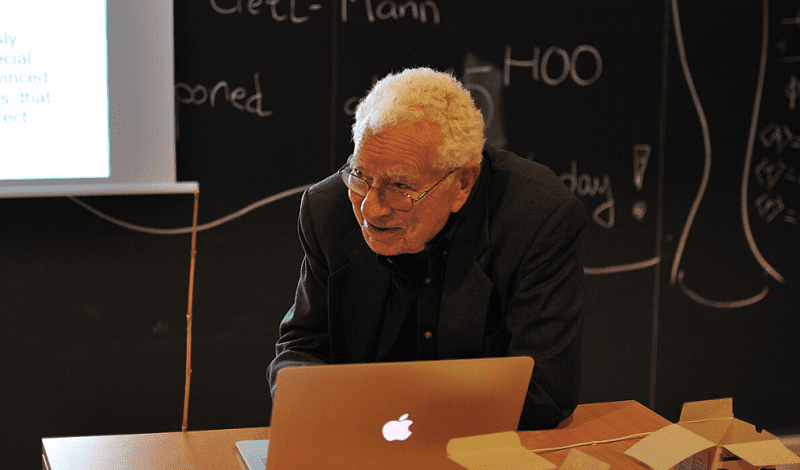

Murray Gell-Mann is a child of Manhattan and conqueror of the atom. On September 15, 1929, in bustling New York (Lower Manhattan), a boy was born whose inquisitive mind would later transform the world of physics. Murray Gell-Mann, a descendant of Jewish immigrants from Austria-Hungary, was fascinated by the mysteries of the universe from a young age. Read more at i-manhattan.
His ancestry, rooted in the lands of modern-day Ukraine, seemed to determine his fate – to become a pioneer, paving new paths in the labyrinth of elementary particles.
Steeped in the atmosphere of a metropolis, Murray grew up in a family where a love for knowledge prevailed. Even at a young age, he impressed those around him with his giftedness, eagerly absorbing information and enthusiastically solving complex problems.
First steps in science
His thirst for knowledge led Gell-Mann to Yale University, where he immersed himself in the world of physics. His curious mind quickly grasped new horizons, and soon he was shining brightly on the scientific stage, taking his first steps toward future discoveries. His contribution to the development of physics is hard to overestimate. His work on the classification of elementary particles and the development of quark theory became a true breakthrough, changing our understanding of the microcosm.
In addition to his scientific activities, Gell-Mann was interested in other areas of life. He was not only a brilliant physicist but also an erudite person who was fond of linguistics, history and philosophy.
Gell-Mann’s journey is that of a tireless researcher driven by a thirst for knowledge. His 90-year life path, like a bright flash, enlightened the world of physics and left a profound mark on the history of science.
In the following publication, we will take a closer look at his path to the heights of scientific Olympus, peek into the laboratory of his ideas, and trace how his discoveries influenced our understanding of the universe.
Murray Gell-Mann was not just interested in the mysteries of the atom but challenged them by unraveling the code encrypted in the chaos of elementary particles.
One of his main achievements was the discovery of quarks – the smallest “bricks” from which mesons and baryons are composed. This revolutionary theory transformed our understanding of the microcosm, shedding light on its architecture.
Gell-Mann did not stop there. He developed the concept of “renormalization” – a mathematical tool that helps physicists understand the peculiarities of the quantum world. His inquisitive mind explored other mysteries as well. He made significant contributions to the study of chirality – a property inherent to elementary particles.
In the 1970s, Gell-Mann became one of the developers of quantum chromodynamics (QCD). It is a theory that describes the behavior of quarks and their “connections” within mesons and baryons with remarkable precision. Gell-Mann’s work laid the foundation for the Standard Model – a grand puzzle composed of elementary particles and the forces that govern the universe.
In 1969, Murray Gell-Mann was awarded the Nobel Prize in Physics for his work on the theory of elementary particles.
Professional life
Murray Gell-Mann was not just a scientist; he was a true apostle of science. Being an honorary professor at several prestigious universities and also a member of the editorial board of the British Encyclopedia, he shared his knowledge. His influence on the world of physics is hard to overestimate. His name is forever etched in the history of science.

Photo source: https://en.wikipedia.org/
CERN, one of the leading global centers for nuclear research, has often been a home for Gell-Mann. His nimble mind knew no bounds, and his thirst for knowledge led him to new discoveries.
In 1984, he became one of the founders of the Santa Fe Institute, where scientists from various fields studied complex systems.
The book “The Quark and Jaguar — Adventures in the Simple and the Complex“ (published in 1994), the title of which refers to Arthur Sze’s poems, reflected his broadest worldview. In it, he disclosed his thoughts on physics, comparing the world of elementary particles to a graceful predator.
Gell-Mann was not just a physicist but a person who bravely went beyond boundaries, forging new paths in the maze of knowledge.
George Johnson’s book “Strange Beauty: Murray Gell-Mann, and the Revolution in 20th-Century Physics” provides insight into Gell-Mann’s personality and his revolutionary contribution to 20th-century physics.
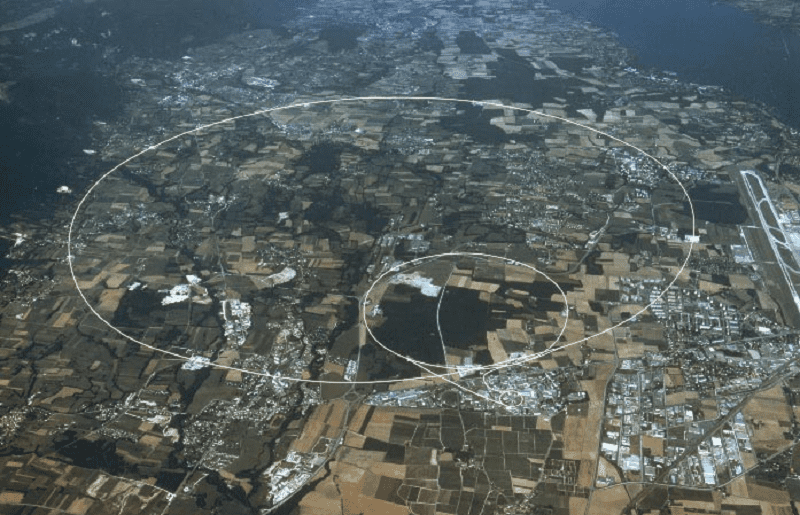
Photo source: https://elementy.ru/
Although Gell-Mann himself did not like that the biography contained some mistakes, it was well-received by his colleagues and made it to the shortlist of the Royal Society’s Book Prize.
In 2023, the Santa Fe Institute released the revised edition of the book, with a foreword by D. Hofstadter, a renowned physicist and computer scientist.
“Strange Beauty” is a valuable resource for those who want to learn more about the life and discoveries of this brilliant scientist.
Personal life of Murray Gell-Mann
In addition to his scientific work, Gell-Mann was interested in other areas of life. In 2012, he co-authored a book with his partner Mary McFadden. It described her life, filled with design, collecting and adventures.
In 1955, he married J. Margaret Dow, with whom he had a son and a daughter. After Margaret died in 1981, Gell-Mann remarried in 1992 to Marcia Southwick. He became a stepfather to her son.
On May 24, 2019, Gell-Mann passed away in his home in Santa Fe. He left behind not only a rich scientific legacy but also an example of determination, curiosity and an insatiable thirst for knowledge.
Scientific contribution
In 1958, Gell-Mann, along with R. Feynman and a team led by George Sudarshan, made a groundbreaking discovery, namely chiral structures of weak interaction.
Their work, known as the V-A theory (vector minus axial vector), came from a discovery of parity violation done by Chien-Shiung Wu. The V-A theory not only explained previously inexplicable phenomena but also became an important step in the development of quantum physics.
Gell-Mann, like other pioneers in this field, helped to understand the fundamental laws of nature that operate at the subatomic level.
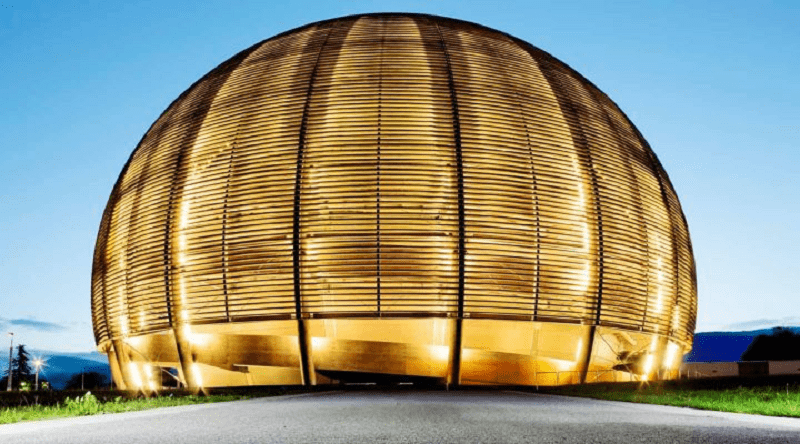
CERN, nuclear research center. Photo source: https://nplus1.ru/
In the 1950s, Gell-Mann began studying recently discovered particles, such as kaons and hyperons. He classified them and found out a quantum number called “strangeness,” which is conserved only under strong and electromagnetic interactions.
Gell-Mann also developed the Gell-Mann-Okubo formula, which was initially based on experiments. Later, his quark model explained it.
He and A. Pais explained the complicated aspect of the mixing of neutral kaons. Thus, he greatly contributed to the comprehension of the universe of elementary particles.
In 1960, a meeting with mathematician Richard Block inspired Gell-Mann to create a new classification scheme for hadrons, which he presented in 1961.
This scheme called the “eightfold way” (a reference to Buddhism), was also proposed by Y. Ne’eman. It was based on the quark model.
Gell-Mann, in collaboration with M. Lévy, created the sigma model of pions. This model describes the low-energy interactions of these particles.
Gell-Mann’s contribution to particle physics was immense. He not only proposed new ideas but also developed mathematical models that described them.
In 1964, Gell-Mann and George Zweig suggested that hadrons, previously thought to be elementary particles, are actually composed of smaller particles called quarks.
Gell-Mann borrowed the name quark from J. Joyce’s novel, while Zweig called them “aces.”
Eventually, quarks, antiquarks and gluons were recognized as the fundamental elements that make up hadrons.
For his discoveries related to the classification of elementary particles and their interactions, Gell-Mann was awarded the Nobel Prize in Physics in 1969.
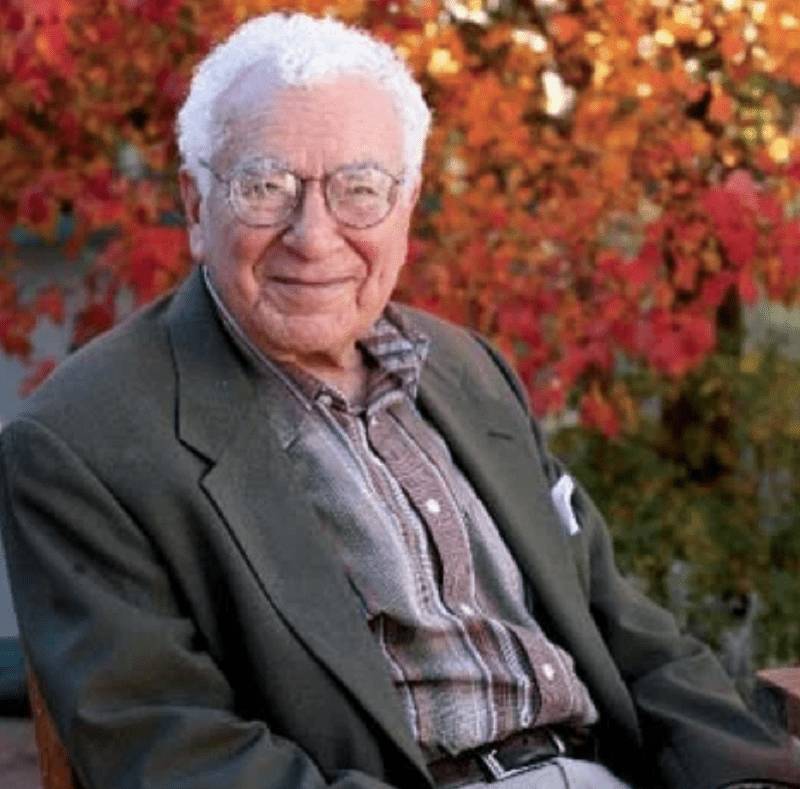
Photo source: https://en.wikipedia.org/
In the 1960s, Gell-Mann developed current algebra, a method based on symmetries for predicting the behavior of quarks. Reliable dynamical theory was not yet available then.
This method resulted in universal sum rules that were later confirmed by experiments.
Gell-Mann’s current algebra served as the foundation for the development of the Standard Model, which is a theory of elementary particles.