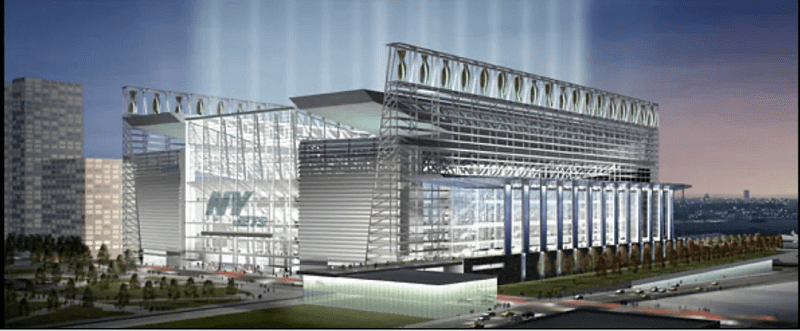

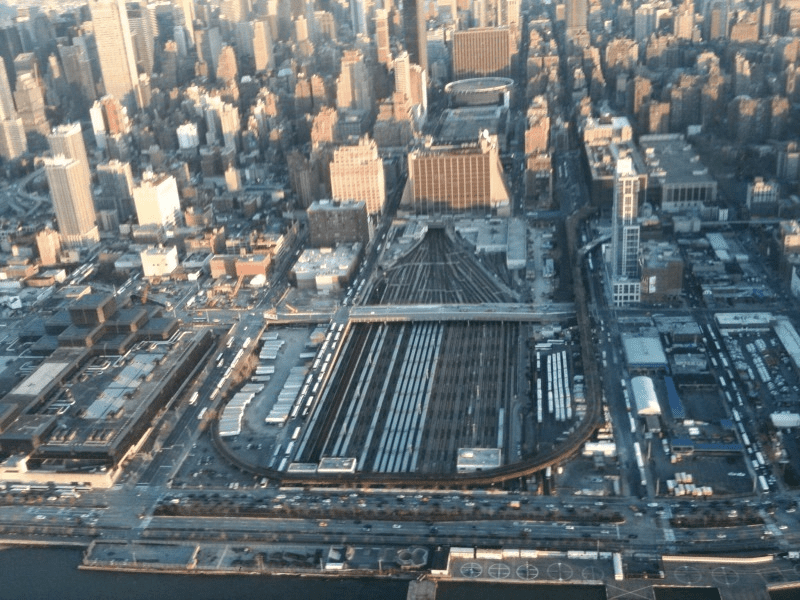
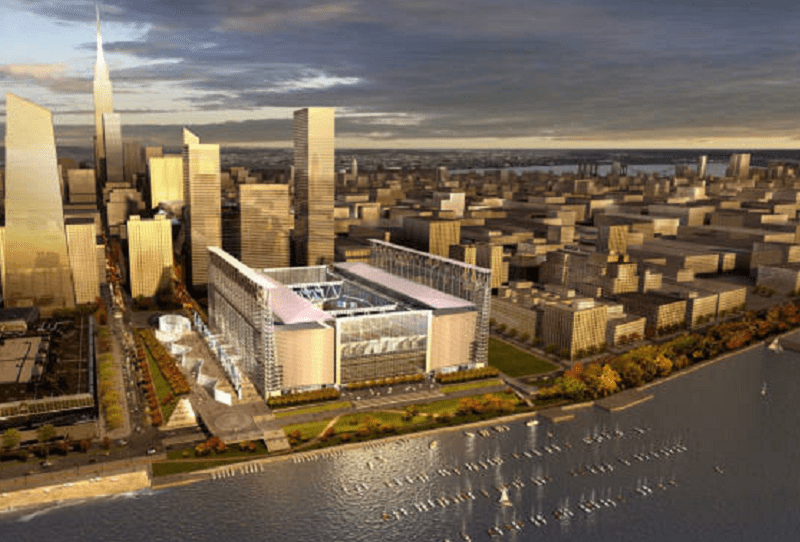
The 80,000-seat stadium was planned to be constructed on a platform above the railroad stations on the West Side, which belongs to the Manhattan side (one of the boroughs of NYC), adjacent to the Hudson River and bordering New Jersey. Let’s turn to history and find out the reasons why the magnificent structure was never built in a rather densely populated area of Manhattan. Read more on i-manhattan.
A major project as part of NYC’s bid to stage the 2012 Summer Olympics
The West Side Stadium (WSS), also referred to as the New York Sports and Convention Center, was intended to be built all-weather due to the retractable roof over the project’s 200,000 square feet (18,600 m²).
The WSS was originally conceived as part of NYC’s bid to host the 2012 Summer Olympics. It was one of the smallest cogs in the global machine that radically transformed the relatively deserted neighborhood of Manhattan’s far West Side.
The all-weather building was to accommodate up to 75,000 people throughout the Olympic Games. After the Games, it could be used as an indoor convention center (with 85,000 seats) and as an outdoor stadium for various sporting events.
[Photo source: https://en.wikipedia.org/]
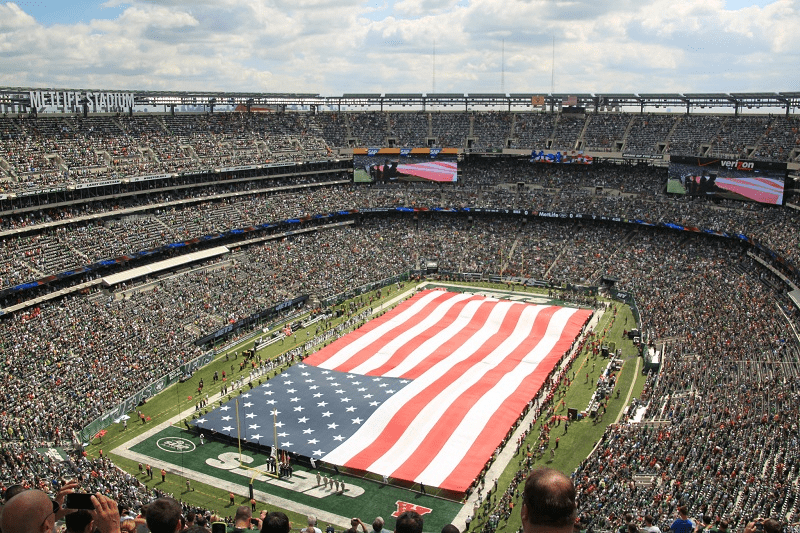
The WSS was to be the site of the New York Jets, a professional sports team from the National Football League, who were at the time junior tenants of the New York Giants Stadium in East Rutherford, New Jersey. However, the idea of a new stadium was rejected a month prior to the International Olympic Committee was to consider and make a decision. During the off-season, the facility was utilized as an annex to the Jacob K. Javits Convention Center for conventions and as a substitute for Madison Square Garden.
The stadium was the brainchild of former Deputy Mayor for Economic Development and Rebuilding Daniel L. Doctoroff. It is now being transformed into a new neighborhood of glass office towers and boulevards that preclude the original project.
The idea of creating such a grandiose stadium was not new to Doctoroff, who became deputy mayor for economic development and rebuilding for NYC under Michael Rubens Bloomberg (108th Mayor of NYC from 2002 to 2013). This idea was actively discussed back in the 90s but reappeared only on the agenda of Bloomberg. He planned to reconstruct lower Manhattan after the infamous events of September 11. This idea was partially disguised as a necessity for the Olympic bid.

[Photo source: https://www.forbes.ru/]
The mayor’s office used the Olympic bid schedule to speed up the process of reviewing and approving various projects so that they could be allowed to start construction regardless of whether the city won the tender or not. This was stated by Mitchell Moss of NYU’s Rudin Center for Transportation Policy and Management in his report How NYC Won the Olympics. Some of the proposals were implemented at the time and are already major city amenities.
The stadium was to be part of a greater undertaking to revive the long-developed area, including the expansion of the Javits Center and the NYC subway line 7.
Financing a global project
The assembly of the stadium provoked a negative reaction from most local government officials and a wave of controversy over the need for global public funding for a substantial engineering project. Many of those who opposed the development understood the need to develop the West Side. But the economic benefits of the stadium, which remained idle most of the time, seemed doubtful. Opponents believed that it would be more appropriate to spend the money on more multifunctional facilities. Proponents, on the other hand, argued that spending more than one billion dollars would be an investment, add several thousand jobs and generate billions in revenue locally. This in turn would increase the amount of taxes for essential infrastructure development.
Bidding
As mentioned above, the stadium was planned to be erected on a platform above the railroad stations owned by the Metropolitan Transportation Authority (MTA). It initially negotiated in private the sale of the territory with the Jets without looking for other prospective buyers. After Cablevision submitted a competing proposal to develop the West Side without a stadium, public opinion forced the MTA to hold an open bidding for the facility’s construction. Three bids were received: from the Jets, Transgas and Cablevision. On March 31, 2005, the MTA voted in favor of the Jets, although Cablevision’s proposal included an additional upfront fee. The company’s attorneys threatened to file a lawsuit to challenge the MTA’s decision, which was criticized in the media as a formal execution of Governor Pataki’s order rather than a decision that would benefit the public.
[Photo source: https://www.stadiumsofprofootball.com/]
Opinions of local residents were divided
Public sentiment was mixed. Some supported the idea of building a stadium to host the 2012 Olympic Games in NYC. To do this, the city needed to show that it had a modern stadium and the necessary resources to host an event of this level.
On the other hand, many inhabitants of Manhattan and the West Side had no desire for resource depletion and endless traffic jams they thought the Olympics might cause. The New York Daily News announced that 59% of residents did not support the idea of the Olympic Games in NYC. In turn, transport companies (commuter trains) filed a lawsuit challenging the city’s assessment. The Tri-State Transportation Campaign and the Straphangers Campaign stated that 70% of stadium visitors would use public transportation or would rather walk than drive. Many Jets fans dreamed of seeing the stadium built at any cost.
The lead architect and urban designer of NYC’s Olympic bid (called NYC2012) was Scott Schiamberg. In an interview, the architect mentioned the proposal to build the WSS and the different opinions that emerged on this basis.
“There are two professional teams from New York, but they play in New Jersey. Sometimes, it’s just hard to build something of this magnitude in a city,” he said.
[Photo source: https://www.chelseanewsny.com/]
In addition, Schiamberg led the process of finalizing the design, the functions of the sliding roof, solar panels and wind turbines, which were quite new and expensive at the time. Another design element was to include flowless urinals in the bathroom to conserve natural water resources.
The proposal also included the construction of a pier to be used for warm-ups before athletics competitions. It was later transferred to the city as a park.
The stadium proposal has accelerated the approval process for many new projects: Brooklyn Bridge Park, Hunters Point South, Barclays Center and the expansion of ferry service between the boroughs.
As for the positive changes for the neighborhood itself, now known as Hudson Yards, they include the extension of the NYC subway line 7, the reconstruction of the Javits Center and changes in zoning. Schiamberg believes that all of this would have happened anyway, but it could have taken 50 years instead of 10.
In a sense, New Yorkers should be happy that the WSS was not realized because of the resulting dramatically changed appearance of the neighborhood, which will become a reality for all residents and visitors for the next few decades.